

What Does a Wolf Eat?

A wolf can eat around three and a half kilograms of meat in a single sitting, then go days without eating again. That pattern, feast followed by fast, explains most of what wolves do and most of what they will accept as food.
They are carnivores, but calling them fussy would be badly wrong. What a wolf eats depends on where it lives, what season it is, and what it can catch that week.
The wolf as a predator
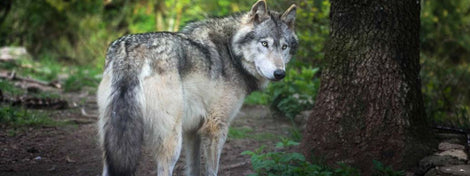
The wolf (Canis lupus) is a carnivorous mammal in the Canidae family, alongside foxes and dogs. It is built for endurance rather than speed: a deep chest, long legs and a gait that can cover ground for hours without stopping.
That build is why wolves survive in places that defeat most large predators. They live across tundra, mountain, forest and open plain, in Europe, North America, Mongolia and Russia, and the same animal handles all of it.
Persecution and habitat loss have made them rare across much of that range, and they are now protected in many countries.

Built for the hunt
Several features matter directly to how a wolf feeds.
- A muscular body and deep chest built for distance rather than sprinting
- A large head with almond-shaped eyes that reflect light at night
- Triangular ears with dark borders and acute hearing
- A long bushy tail used for balance and for signalling
- Thick fur in white, grey, brown, ochre or red depending on region
The sense of smell does most of the work. A wolf can detect prey well over a kilometre away in the right conditions, which matters far more than eyesight when tracking across country. Each animal also carries a distinct scent from a gland near the base of the tail, which is how family members identify one another.

Hunting as a family
Wolves live in family groups, typically six to twelve animals, centred on a breeding pair and their offspring. Hunting together is what allows them to take prey many times their own size.
The method is patient rather than dramatic. A pack will track a herd over a long distance, watch for an animal that is old, young, sick or simply slower than the rest, then separate that individual from the group before closing in. Most hunts fail. The ones that succeed usually do so because the target was already at a disadvantage.
That selectiveness is why wolves are described as a keystone species. By removing the weakest animals, they change how prey herds move and graze, which in turn changes the vegetation and the watercourses. Remove the wolves and the whole system shifts.
What is actually on the menu
The core of the diet is medium to large hoofed animals.
- Deer, elk, moose and caribou across most of the range
- Sheep, goats and wild pigs where those are available
- Bison in parts of North America, and seals along some coasts

When large prey runs short
This is where the reputation for pure carnivory breaks down. A wolf that cannot find a deer does not starve on principle.
- Smaller mammals: rabbits, rodents, ground squirrels
- Birds, fish, amphibians and reptiles
- Carrion, which they will take readily rather than pass by
- Fruit, berries and some plant matter, particularly in late summer
Berries in particular turn up in wolf scat far more often than most people expect. It is not a large part of the diet by calories, but it is a real one.

Feast and fast
Wolves eat in a way that looks alarming and makes complete sense. When a hunt succeeds, they consume as much as they can hold, which is where the three and a half kilogram figure comes from.
Very little is wasted. A pack will strip a large carcass over several days, returning to it, and what they leave feeds ravens, foxes, bears and eagles. A wolf kill supports a considerable number of animals that never took part in the hunt.
Between kills they may go several days with nothing at all. That tolerance for irregular feeding is one of the main reasons the species survives in places where food supply is unpredictable.
As a token of our appreciation, enjoy a 10% discount on our entire store with the promo code: WOLF10
The animal on your wall
The wolf as a hunter, patient and built for distance, is the version that turns up most often in artwork.
Our wolf painting collection covers forest and snow compositions where the animal is placed in its environment rather than isolated against a background.

For the same subject in textiles rather than framed art, our wolf blanket collection and our wolf decor collection cover throws, bedding and lighting.