

What Does the Wolf Totem Mean?

The wolf is one of the most commonly claimed spirit animals, and one of the most misread. Most of what gets written about it leans on the reputation for ferocity, which is the least accurate thing about the animal.
The traditions that actually built the symbol were paying attention to something else entirely: loyalty, communication and restraint.
What the wolf is understood to represent
Across most traditions the same handful of qualities recur.
- Instinct, and trusting it over deliberation
- Intelligence, particularly the practical kind
- Freedom, and resistance to being tamed or owned
- Loyalty to family and to the group
- Communication, since no animal of its size talks as much
The less flattering readings are part of it too. A wolf appearing in a difficult context is traditionally read as a signal about feeling threatened, or about a lack of trust either in somebody else or in your own judgement.

The reputation is wrong, and the reality is better
Wolves are usually described as aggressive animals that attack without provocation. Very little about that survives contact with the research.
Wolves go to considerable lengths to avoid fighting. Most territorial disputes are settled by howling and scent marking precisely so that nobody has to fight, because an injured wolf is a wolf that may not eat. They stand their ground when they must and rarely start anything.
That is a considerably more useful symbol than the one it replaced. The wolf as a totem is not about being the most dangerous animal in the room. It is about being capable enough not to need to prove it.
It is also worth knowing that a healthy adult wolf almost never attacks a strong adult human. The reputation was built on livestock losses and on stories, not on records.

The lone wolf, and what it actually means
The lone wolf is the most borrowed part of this symbolism and the most misunderstood.
In the wild, a lone wolf is not a rebel who rejected the group. It is a young animal that has left its family to find territory and a mate of its own, and the state is temporary by design. It is also dangerous: dispersing wolves have far lower survival rates than those still with a pack.
Read symbolically, that is a more interesting idea than the usual one. The lone wolf is not somebody who does not need anybody. It is somebody in transition, between the family they came from and the one they have not built yet, and the point is to come out the other side.

Native American traditions
The wolf carries weight across many nations, and the meaning is not uniform. In some it is a great good; in others it carries genuine danger. Both readings often sit in the same tradition.
Hunting peoples in particular treated the wolf as a great warrior and a teacher. The qualities associated with it commonly include devotion, resourcefulness, protection and fertility.
Some traditions place the wolf far further back than that, as an ancestor or a figure present at creation.
Where specifics can be named: several Pueblo traditions treat the wolf as guardian of the East, and among the Zuni the wolf image is carried for protection and wellbeing.
Our article on the wolf in Native American tradition covers this in more depth, including the Nuu-chah-nulth wolf dance.
China, split down the middle
Chinese tradition divides sharply by region, and the split follows the geography exactly.
In southern China the wolf was largely an omen of danger and death, which fits a settled agricultural society that met wolves mainly as a threat to livestock.
In the north the reading is close to the opposite. Wolves stood for strength, courage and cooperation, and their image was worked into weapons. Northern myths describe wolves carrying the spirits of the dead up to an ancestral god.
The difference is not mystical. Northern China borders the steppe, where herding and hunting peoples lived alongside wolves and understood them as competitors rather than monsters.
The Celtic wolf
In Celtic tradition the wolf blurs into the dog, and the symbolism the two share is bravery, loyalty and integrity.
The wolf appears most often as a guide and a companion, walking with Cernunnos, the horned god of wild places and animals. That places it firmly on the side of the forest rather than against it.

The wolf sign, and where it comes from
You will often see the wolf listed as a birth sign covering 21 January to 19 February, with the associated traits being foresight and a strong sense of family.
Worth being straight about the provenance. This belongs to a modern system usually marketed as Native American astrology, and it was assembled in the twentieth century by mapping animals onto the twelve Western zodiac months. It is not an Indigenous tradition, and the nations it borrows names from did not use it.
Enjoy it as a modern symbolic system if you like it. Just do not mistake it for something ancient.
One correction while we are here
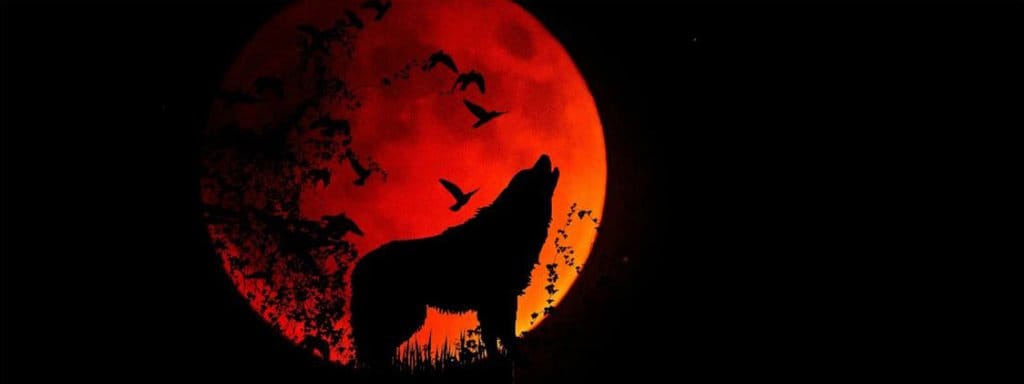
Wolves do not howl more during a full moon. They howl more at night, and a full moon simply makes the night one people notice.
The raised muzzle is about carrying sound further, not about the moon. Our article on why wolves howl covers the acoustics.

The wolf in dreams
Dream readings of the wolf turn on how the animal behaved rather than on the animal itself. A watching wolf is generally read as guidance, an attacking one as something in your own conduct that has got away from you, and a pack as a question about your relationships rather than yourself.
Our article on what a wolf means in a dream covers the readings by colour and behaviour.
Carrying the totem
Most people who take the wolf as a personal symbol end up wearing it, which is the oldest form of this there is.
Our wolf jewelry collection covers rings, pendants, bracelets and watches, and our wolf necklace group in particular carries the Viking and totemic designs that come closest to the traditions above.

For the same imagery in a room rather than on a hand, our wolf decor collection covers art, textiles and lighting.