

White Wolf: A Robust Animal

The Arctic wolf lives somewhere almost nothing else can. Temperatures on its range drop to sixty below, the ground is frozen for most of the year, and prey is so thinly spread that a single family may need three thousand square kilometres to feed itself.
Everything about the animal follows from that.
Living at sixty below
The white wolf (Canis lupus arctos) is a subspecies of the gray wolf, adapted specifically for the high Arctic.
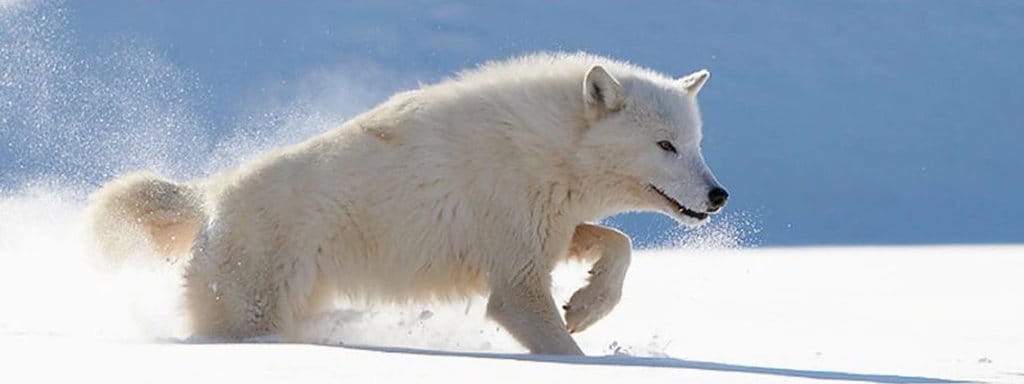
Its coat is the obvious adaptation. The fur is dense enough to hold body heat down to around seventy below, considerably colder than the animal will normally encounter, and unlike most wolves it keeps its pale colouring all year rather than changing with the season.
The less obvious adaptations matter as much. Arctic wolves have shorter ears and a smaller muzzle than gray wolves do. Extremities lose heat fastest, so in the coldest places on earth the successful animal is the one with less of them exposed.

Where they range
The population sits across the northern reaches of the northern hemisphere: northern Canada, Alaska, and the northern and eastern coasts of Greenland. Animals turn up occasionally further south, including in Wood Buffalo National Park in Alberta.
Several regional forms fall under the same pale phenotype: the Arctic wolf itself, the Alaskan wolf, the Alaskan tundra wolf and the Baffin wolf. The Newfoundland wolf belonged to the same group and no longer exists.

Smaller than you would expect
Arctic wolves are compact rather than large, which surprises people who assume the coldest environment produces the biggest animal.
Body length runs to around 90 cm with a shoulder height between 65 and 80 cm, and a tail of about 30 cm. Adults weigh between 45 and 80 kg. Alongside that comes a jaw built for frozen carcasses, with long pointed canines that tear rather than crush.
Two other numbers stand out. An Arctic wolf can sprint at up to 60 km/h, and each animal has a voice distinctive enough to be recognised individually across roughly eight kilometres of open ground.

Feeding where there is almost nothing
Diet is dictated by scarcity rather than preference.
When hunting as a family, Arctic wolves take muskox and caribou, which is remarkable given the size difference and only possible because they work together. Muskox in particular form defensive rings, and breaking one takes patience rather than force.
The rest of the time they take what is available: hares, lemmings, ground birds and rodents. In the brief summer they will feed on mice and frogs without complaint.
Scent does the finding, with prey detectable at around 500 metres. A kill is made at the throat, and very little is left behind: flesh, bone and hide all go, because the next meal is not guaranteed. A wolf will take one and a half to two and a half kilograms of meat in a day when food allows.
Raising cubs in a short summer
Packs run to around ten animals, centred as always on a breeding pair who are usually the only two to reproduce.
Territories are vast, up to 3000 km², simply because prey is so thin. Mating happens once a year, and the timing is not optional: the climate leaves only a narrow window in which cubs can be raised at all. Sexual maturity comes at two to three years, gestation lasts about two months, and one to five cubs arrive between May and June.
Cubs are born blind and deaf, weighing 400 to 500 grams. They can eat meat at around two months, at which point the whole family shares the feeding.

Digging in frozen ground
Denning is harder here than anywhere else, because the ground is often permanently frozen. Arctic wolves make use of caves, rock outcrops and shallow depressions rather than digging deep, which is one more constraint the southern populations do not face.
Staying in touch across empty country
With territories that large, communication has to work at distance. Howling does the heavy lifting, keeping a scattered family in contact and warning other packs off. Body signals handle everything at close range.
Why they are not protected
The Arctic wolf carries no protected status, and the population is estimated at around ten thousand.
That sounds comfortable and is not. The species has effectively one predator, and it is us. Hunting for fur remains the main pressure, and a population spread that thinly across country that remote is difficult to monitor, let alone defend.
The one advantage the Arctic wolf has over its southern relatives is that almost nobody wants its habitat.
The white wolf in decoration
Pale wolves against snow are among the most reproduced images in the theme, largely because the contrast does the work for the artist.
Our wolf painting collection covers snow and winter compositions in several sizes.

For a smaller piece, our wolf figurines collection includes polar and white sculpted models.