

How Are Wolf Packs Formed?

Almost everything written about wolf packs online describes a ranked hierarchy: an alpha at the top, a beta enforcer below, a gamma scout, and an omega at the bottom absorbing the group's aggression. It is a compelling structure. It is also, for wild wolves, wrong.
The reality is simpler and, once you know it, considerably more interesting. A wolf pack is a family.

Where the alpha model came from
The ranked hierarchy entered popular understanding through a 1970 book by the American biologist L. David Mech, drawing on research into wolves held in captivity. In that setting the model held up. Unrelated adult wolves, placed together in an enclosure with no choice about it, did form dominance ranks and did fight over status.
The problem is that a captive group of strangers is nothing like a wild pack. Mech himself spent much of the following decades trying to correct the record, asking his own publisher to stop reprinting the book and writing repeatedly that the alpha framing does not describe wolves living free.
By then the idea had escaped. It was simply too good a story, and it had already been borrowed by dog trainers, management books and a great deal of the internet.
What a wild pack actually looks like
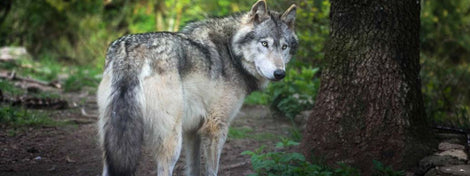
A wild wolf pack is a breeding pair and their offspring, usually numbering somewhere between two and twenty animals depending on prey and territory.
The two adults at the centre are not there because they defeated rivals. They are there because they are the parents. They lead in the way parents lead: they have more experience, they make the decisions about where to travel and when to hunt, and the younger animals follow because following works.
The younger wolves are their pups from the current year and previous years. As those pups mature, most disperse to find territory and a mate of their own rather than staying to climb a ladder that does not exist.

What this means for the alpha, beta and omega
Once you see the pack as a family, the ranks resolve into something more ordinary.
The alpha wolf
The breeding pair. They eat first, they choose the den site, and in most packs they are the only wolves that reproduce. All of that is true, and it is why the word survives as useful shorthand. What is not true is that they fought their way there. Read alpha wolf for a fuller account of what the breeding pair actually does.
They do carry themselves differently. A breeding male moves with his head and tail high and his ears forward, and younger animals adopt the opposite posture around him. That part of the old description was accurate observation; only the explanation was wrong.
The beta wolf
Usually an older offspring who has not yet dispersed. Larger and more experienced than the yearlings, often the first to respond to a threat, and sometimes the animal that takes over breeding if a parent dies. There is no formal rank being enforced, but the description matches a real animal.
The omega wolf
The idea of a designated scapegoat absorbing the pack's tension is the least supported part of the model. In wild families, the lowest-ranking animal is usually just the youngest. What looks like ritual humiliation in captivity is mostly the ordinary submission of a juvenile to an adult.

How a pack holds its ground
Whatever you call the animals in it, a pack defends a territory, and the mechanics of that are well documented.
Boundaries are marked with scent, urine and scratches at visible points along the edges of the range, placed where a rival travelling through cannot miss them. Howling does the same job over distance, announcing occupancy to anyone listening from several kilometres away.
Breeding is seasonal and limited. The breeding female produces one litter a year, typically four to eight pups after around two months of gestation, and the whole family contributes to feeding and guarding them.

Why the old model refuses to die
Partly because it is simpler to explain, and partly because it flatters the reader. A story about fighting your way to the top of a hierarchy has obvious appeal, and it has been repeated so often that it now sounds like established fact rather than a retracted hypothesis.
It is worth knowing the truth anyway, because the real version is a better story. Wolves are not gladiators arranged by rank. They are families that raise young together, hunt together and hold territory together, and they are extremely good at it.

Wearing the symbol
The pack still means what people take it to mean: loyalty, family and the strength that comes from acting together. That is a large part of why wolf imagery carries the weight it does.
Our wolf ring collection includes signet designs such as the Wolf Signet Ring Lone Wolf, which is the piece people most often choose to mark exactly that idea.

For the wider range, our wolf jewelry collection covers rings, necklaces, bracelets and watches, and our wolf decor collection carries the same imagery at room scale.