

What Is a Black Wolf: The Complete Portrait

A black wolf is not a separate species, and it is not a rare mutation that appeared out of nowhere. It is a gray wolf carrying one specific gene, and the story of where that gene came from is the most interesting thing about the animal.
It came from dogs.
Why some wolves are black
Black coats in wolves are caused by a variant at a gene known as the K locus. Studies of North American wolf populations traced that variant back not to wolves at all but to domestic dogs, entering wild populations through interbreeding thousands of years ago, when the first dogs arrived on the continent with people.
The gene then spread, because it turned out to be useful. Black coats are far commoner in forested country than on open tundra, which suggests the colouring earns its keep in the environments where it is common rather than being a neutral accident.
The result is that the black wolf is a wild animal carrying a piece of domestic ancestry, which is a neat reversal of the usual story about wolves becoming dogs.
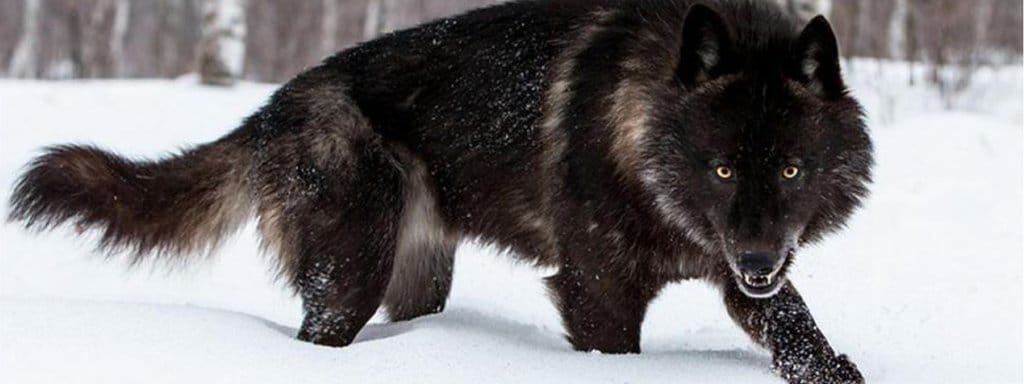
Where black wolves are found
Most belong to Canis lupus occidentalis, the northwestern wolf, which also includes the Mackenzie and tundra populations. In Canada the animal is often called the Alberta wolf.
The core range is the far north of Canada and Alaska, extending through the coniferous forests of Eurasia and North America, the Rocky Mountains and the taiga. The Northwest Territories of Canada alone hold a population of roughly ten thousand.
Melanism is rare across wolves as a whole but turns up right across the northern hemisphere, including Western Europe, with recorded animals in Italy.

Built for the north
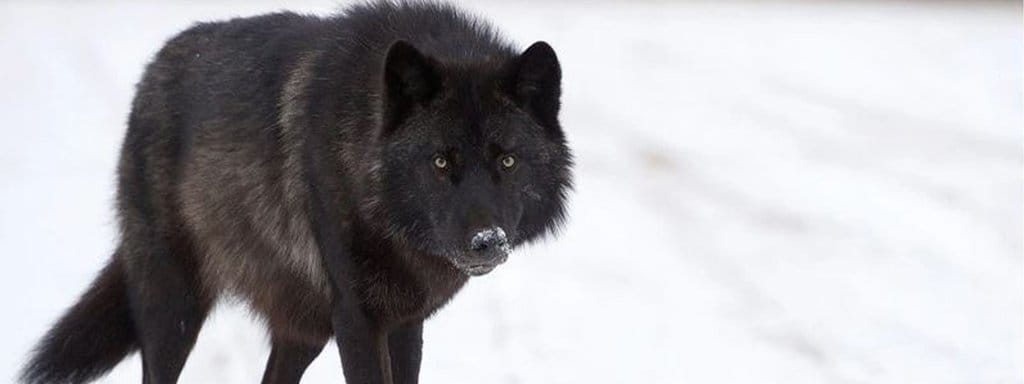
These are among the largest wolves anywhere. An adult stands around 80 cm at the shoulder and weighs 60 to 80 kg, with males roughly twenty percent heavier than females.
The head is large, the forehead broad, the ears comparatively short, and the feet unusually wide. That last detail matters more than it sounds. Broad soles spread the animal's weight across snow the way a snowshoe does, which is the difference between travelling and sinking.
The senses are the other half of the equipment. A black wolf can pick up scent at around 300 metres, sprint at roughly 50 km/h, and see well enough in near darkness to hunt through an Arctic night.

Hunting in the taiga
Black wolves hunt as a group, using scent to locate prey and endurance to break it down over distance rather than catching it outright.
The staple is large hoofed prey: elk, bison, caribou and white-tailed deer. When those are scarce, and in the far north they often are, the same animals take beaver, hare, rodents and birds, and will feed readily on carcasses they did not kill.
That flexibility is what makes them ecologically important. As a top predator they regulate ungulate numbers, which protects young trees from being grazed out, and they clear carrion from the landscape as a side effect.
Family, territory and dens
Packs run from four to twelve animals and hold territories of somewhere between 80 and 240 km², varying by region and prey density.
As with any wolf family, the breeding pair leads. They are the only animals in the group that usually reproduce, and the rest are their offspring from previous years. Boundaries are marked with scat and urine, reinforced by howling that carries the message further than any scent mark can.
Dens are dug into the ground, typically under rock and close to water, and used in spring for a litter of four to six cubs. Young animals that reach maturity leave to establish packs of their own, which is how the range keeps refilling itself.
Seeing one in Europe
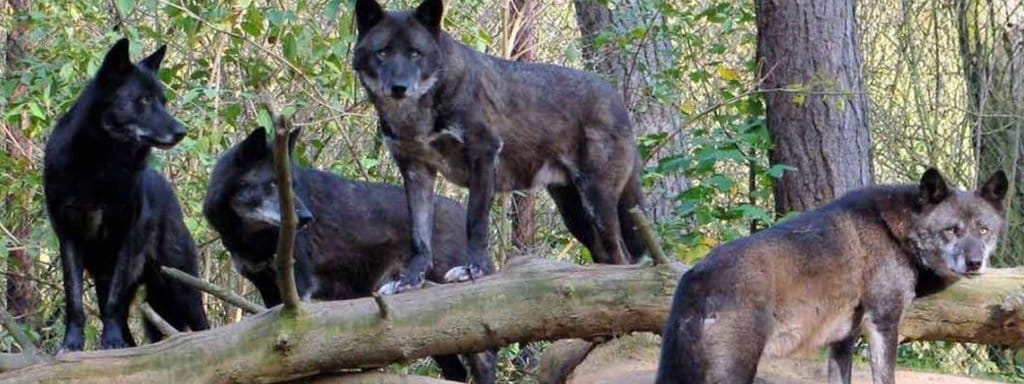
Two French parks make this possible without a trip to Canada. The Parc Animalier des Pyrénées keeps wolves in enclosures designed for observation, and the Sainte-Croix Wildlife Park received seven Canadian wolves, locally called Timberwolf, from Givskud Zoo in Denmark in November 2019.
What Yellowstone showed
The reintroduction of wolves to Yellowstone National Park is the best documented example of what these animals do to a landscape. Elk numbers and behaviour changed, overgrazed riverbanks recovered, and species that had thinned out returned as the vegetation came back.
It is a useful corrective to the older view of wolves as purely destructive. A predator that removes the weakest animals from a herd turns out to be doing structural work for everything else in the system.
The black wolf as a symbol
A black coat reads differently to a grey one, which is why it recurs in design far out of proportion to how common it is in the wild. It sits closer to the mythological wolf than to the biological one.
Our wolf figurines collection includes sculpted black pieces where the colour does most of the work.

For something worn, our wolf hoodie collection carries the darker designs at the scale they need.